Showing posts with label mathematics. Show all posts

August 4, 2015

Beyond Words – and Back

William James was a major figure in 19th century American philosophy. Indeed, he is sometimes referred to as the Father of American Psychology. He was a rigorous thinker but also had a sympathy to religious experience, particularly of the mystical type.

According to James, one of the characteristics of mystical experience is that it can’t be put into words. I’m not sure if it was James who started this idea but certainly many scholars of religion make similar pronouncements: mystical experience cannot be talked about at all, what to say in precise language. At one time I believed such pronouncements because scholarly authorities had made them and also because some Buddhist masters concur. However, at this point in my life, I strongly disagree with the notion that it’s impossible to describe mystical experience precisely.

Of course, it’s true that in order to have mystical experience on a consistent basis, a person has to work through the drive to think in words. So, yes, one part of the mystical journey involves the struggle to get beyond words. But another part involves the struggle to describe in words how to get beyond words, and to describe in words what the experience of getting beyond words is like. There are many ways to get beyond words. You can find one possible description of how to get beyond words by following the ten steps presented here (pp. 39-46). Step 10 - Dance At The Source describes in words (and pictures!) what it’s like to go beyond words. You can find a more detailed breakdown here.

As most of you know, mathematics is a bit of a hobby with me. Recently I discovered a little known byway in the history of early 20th century math—an interesting dialectic between European and Russian mathematicians.

Set theory is the most commonly used foundation for mathematics, and mathematics is foundational for science, so set theory might say something deep about the mind, if not nature itself. One initial problem with set theory was that, if one accepts certain seemingly reasonable assumptions, it can lead to weird stuff and paradoxes. Not just things like Russell’s Paradox (which many people are familiar with), but really weird stuff, like the Banach–Tarski Paradox.

According one historian, Loren Graham, some of Russia’s most famous early 20th century mathematicians were followers of a renegade Eastern Orthodox sect called Imiaslavie. The Imiaslavie theologians firmly believed that God could be precisely named. According to Graham, this emboldened the Russian mathematicians to pursue certain implications of set theory that their more rationalistic European counterparts were unwilling to face.

I’m not sure how relevant this bit of esoterica is to my disagreement with James and other authorities. But, if nothing else, it’s an interesting little byway in the history of science that I thought to share with you.

You can read about it towards the end of this short article.

Also check out this interview with Loren Graham on SoundCloud:


March 17, 2015

I’ve decided to convert to Tau-ism

© Kerstin/dragonflyducky @ Flickr
Some of you may know that Saturday was a particularly significant Pi Day. During the morning Home Practice Program, I asked participants to observe a moment of silence in honor of Archimedes as we transitioned to the Pi Instant at 3/14/15 - 9:26:53 am EST.

Apropos of Pi Day, one of my computer scientist friends, Neal McBurnett, sent me this really cool Youtube segment by Michael Hartl, formerly of Caltech. It’s about the tongue-in-cheek geek war between pi and tau.

I’ve decided to take Hartl’s message to heart and, from now on, I’ll be practicing and advocating “Tau-ism.” Check it out if you like geeky fun stuff.

August 11, 2014

Who Meditates?

I received the following comment on one of my previous blogposts and wanted to respond to it with an independent posting.

“If there is no self in All Rest…then who is seeing and noting?”

It raises an extremely interesting and deep question around which there seems to be an enormous amount of confusion. I'd like to make a few observations that may be helpful.

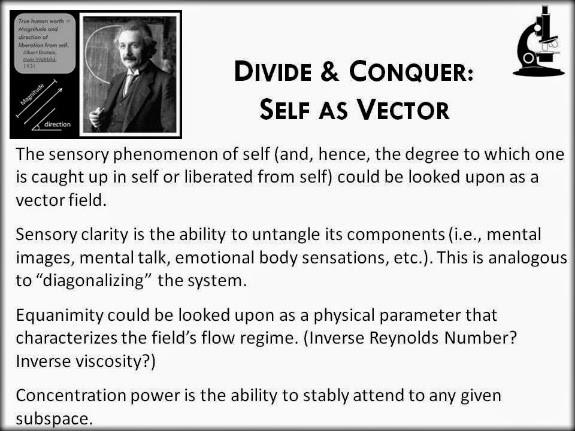
I give a standard power point presentation that outlines my hope for how science and mindfulness could cross-fertilize with each other to the dramatic benefit of humanity. In that presentation, I mention an interesting quote by Albert Einstein. Here are the relevant slides.


So Einstein said: “True human worth equals the magnitude and direction of liberation from self.” What’s revealing about this quote is that Einstein, having been trained in mathematics, is thinking of the endeavor of transcending self as a vector-valued function rather than a scalar-valued function. Translated into ordinary English, that means that in fact “No Self” is a multi-dimensional phenomenon. Put another way, there are various sizes and flavors of experience that might be described as No Self.

One flavor of No Self would be a spontaneous deactivation of inner See-Hear-Feel activity (See Chapter 1 of my manual).

Another flavor of No Self comes about when the mind-body elements get disentangled (See The Five Khandhas paradigm of early Buddhism).

Yet another flavor of No Self comes about when we dis-identify with the Content of mind and body and re-identify with the Flow (See Chapter 4 of my manual) and Contour of mind and body.

Yet another flavor of No Self comes about when we can detect the continuous goneness of every experience and, furthermore, identify with the Goneness and disidentify with the mind and body.

As to the central point in your question, which, if I paraphrase, boils down to

“If there is no self, who is meditating?”

The quick answer is “the habit of meditating is meditating,” just like the habit of driving the car can drive the car even when you have no conscious perception of a driver.

For more details see the following videos (with thanks to Har-Prakash Khalsa):


December 9, 2013

Mathematics for Mystics: Welcome to my Geek Out

I’ve recently been having some cool email exchanges with a professionally-trained mathematician, Newcomb Greenleaf. He now teaches in the Individualized BA program at Goddard College, and is on the board of the Yoga Science Foundation.

Just for the fun of it, I’m including a few excerpts here.


I said:
Here are some thoughts on category theory but, first, a big disclaimer:  I am a total dilettante amateur in mathematics. No formal training whatsoever--or, rather, my formal training ended at Venice High School, where I flunked beginning algebra three times in a row (much to the chagrin of my parents!). I only know what I've picked up on my own through books and the Internet. I'm also acutely aware of how easy it is to "see the Virgin Mary in your danish", i.e., see what you want to see in science and math results. Newton thought the attractive power of universal gravity was a reflection of God's love (so by that logic, is dark energy proof of God's hate?). Maupertuis was convinced that the Principle of Least Action, proved God's existence. (Voltaire wrote a parody of him called Doctor Akakia.) Even Leibniz, who by all accounts was probably one of the most versatile western intellects of all time, believed that mod-2 arithmetic demonstrated how God could make something (1) out of nothing (0). These guys represent the cream of professionals, and I'm just a dilettante amateur! So having stated all of this by way of caveat, here are the parts of category theory that seem to resonate with Buddhism and my personal meditation experience. 
Connection is a huge theme in Buddhism. It's elaborated philosophically in the doctrine of pratītyasamutpāda. The slogan is "This being that is." Indeed in the Mahayana formulation, there aren't even entities--just connections. As you know, category theory is all about arrows--different flavors of arrows connected in various ways. Paralleling Mahayana, it's even theoretically possible to do away with the objects themselves. So, in a sense, both Buddhist philosophy and category theory seem to say "it's arrows all the way down." https://mail.google.com/mail/e/330  
Moving on to a different theme, in the way I like to formulate impermanence, binary contrast is very important--different ways in which self-cancelling polarities can mold experience. In my system, this is formulated in terms of expansion-contraction (check out more about this herehere, and p. 56 on here...). One important class of categories are "pointed categories" or "categories with a zero object". The arrows in these categories all start from zero and return to zero--which sounds an awful lot like  how I experience consciousness working). I talk a bit about the history of zero in my article Algorithm and Emptiness--here's the link. I also talk about related issues on pp. 151-159 and pp. 173-183 in my Five Ways manual. 
So to the extent that category theory generalizes group theory, the theme of mutually cancelling polarities is a major theme, and that maps on to my meditative experience rather nicely. Category theory then goes on to generalize invertibility itself with the notion of adjoint functors. Although the language is just coincidental, I love phrases like "forgetful functor" and "free functor." In contemplative practice, we first forget our specific identity, which then frees us up to assume arbitrary identities. Once again, I'm very aware that the language used here is merely coincidental, but I do find it amusing.  
Moving on, at the most universal level, arrows can always be reversed. There's this incredibly beautiful duality principle that pervades every facet of category theory. Pythagoras, Lao-Tzu, Hegel, and Marx would all be pleased. 

Newcomb responded:
I felt privileged to allow the elegance of your mathematics to enhance the punch of the dharma. Tangibly, they have inspired me to re-examine my understanding of the foundations of math in categorical terms.  I've had to recall my rather checkered history with categories. In graduate school I was good friends with Peter Freyd, whose thesis became the first book about category theory, which up 'til then was treated in the context of algebra or geometry or topology.  It's called Abelian Categories, and I find that it's still in print. I learned to think categorically I recall Peter's excitement and particularly his emphasis that, "We used to think that category theory just did away with the elements.  Now we see that it also does away with the objects." and it's nice to see that insight again.  

To which I responded: 
I'm totally awestruck/starstruck that you were good friends with Peter Freyd.