Shinzen's blog has migrated to: www.shinzen.org/blog. Check it out, bookmark it, and subscribe at that page!
For those of you who have subscribed via the subscription on this blog, we'll be emailing soon to notify you of the transition.
In the Shinzen's words:

September 2, 2016


August 19, 2016
The Grateful Dead - A Follow Up
I received a great question on my Grateful Dead post that I'd like to follow up on here.
Could you clarify what you mean 'The more dead you are in life, the more alive you’ll be after death', is this related to cessation and/or no self? Do you have any fear of death? What is best to emphasize in practice to achieve this?
Yes, it’s definitely related to cessation and no self. But just about any practice should be a good preparation for death if you develop it to an industrial strength level of "CC&E".
Sometimes it's useful to distinguish death in the sense of no longer existing, from death in the sense of going through the dying process. Noting Gone would probably be a good preparation for death in the sense of no longer existing. Noting Gone leads to an appreciation of the paradoxical richness of Nothing. A life of noting Gone is a life of intimacy with the richness of death. That's what I meant by the somewhat enigmatic claim: "the more dead you are during life, the more alive you'll be after death."
Regarding, preparation for the dying process, familiarity with restful states and familiarity with expansion and contraction can be helpful. Basically, when a baby comes into the world, it does so through the peristalsis of its mother's womb. That peristalsis represents the expansion and contraction that pervades of all of nature. When we pass out of existence, those same polar forces grind away the somethingness of self and world. If things go well, you’ll re-identify with those forces, and become your formless parent—thus, in a sense, “sidestepping” your personal demise. Not everyone is fortunate enough to experience the dying process that way. On the other hand, almost anyone can experience the dying process in terms of ever-deepening states of pleasant rest: visual rest (darkness or bright light), auditory rest (mental talk gets wiped away, the ear defocuses), and body rest (you're so exhausted that you don't want to move even a tiny bit. This can induce a continuous and profound global relaxation). When I'm asked to guide someone through the dying process, I typically have them focus on See Rest, Hear Rest, Feel Rest, and it almost always works. Of course, I'm usually working with people who already have a meditation practice, but not inevitably. I've also had success using rest states to facilitate the passing of non-meditators.
Am I afraid of death? All I can say is this: I have no doubt that if I had not done all those decades of practice, I would be quite concerned on a daily basis with the prospect of my own mortality (I turned 72 a few days ago). That doesn't seem to be happening much. To be honest, I have no idea of what my reaction will be when the end comes. However I am quite confident that some part of me will know exactly what to do, regardless of what may arise.
May 27, 2016
Auto Think: A Strategy for Fostering the Wisdom Function
The word “science” can be used to denote two different but related things:
The Sanskrit word prajñā, usually translated as wisdom, has a similar double denotation. It refers to:
The two sides of wisdom are symbolized in the attributes of the bodhisattva Manjushri: in one hand he holds a book, symbolizing the content of wisdom, and in the other hand he holds a sword, symbolizing the activity of wisdom. You can study the books, but that probably will not be enough; You also have to practice wielding the sword, i.e., systematically cultivate the wisdom function within you.
There are many ways to cultivate the wisdom function. In the early Buddhist formulation, the wisdom function is developed through careful observation of sensory experience. But The wisdom function can also be cultivated by maintaining equanimity with Don’t Know (as in koan practice) or by noticing the primordial perfection that’s always there (as in Dzogchen), or by merging inside and outside through high concentration (as in Raja yoga).
Recently I’ve been working on a novel strategy for fostering the wisdom function. In this approach, you first become familiar with something that I call a “global unfixated state” in the mind. Then you notice when wisdom thoughts arise spontaneously from that state. I call this technique Auto Think.
Auto Think proceeds in four steps. Step 1 is immediately doable by everyone, even a rank beginner, and can often be quite powerful. Step 2 is also doable by anyone but may require some practice. On the other hand, Steps 3 and 4 are relevant only if certain windows spontaneously show themselves. If those windows arise, you proceed to those steps. If not, that’s okay; there’s plenty to learn and experience in the first two steps.
In this particular context, the phrase “mind states” refers to the above four possibilities. In mindfulness practice, one is sometimes asked to “observe thoughts.” But usually rather little systematic instruction is provided for how to do that. Perhaps you’re asked to monitor thought in a general way or to identify categories such as memory, plan, fantasy, judgment, and so forth. Of course, if those approaches work for you, then fine. But in my experience, analyzing thought in terms of its basic sensory composition is more powerful than observing it in terms of general content. By basic sensory composition, I mean the four possibilities mentioned above.
After you’ve gained momentum with noting mind states, if you wish you can move on to Step 2.
Mind space = image space + talk space. By image space I mean the locations where you detect visual thoughts. By talk space I mean the place where you hear mental dialogue and monologue.
As you explore evenly covering mind space, you may encounter a characteristic wall or a characteristic window (or neither of those).
But what’s a “global unfixated state”? The definition involves some subtlety and complexity, but it’s worth investing a little time to grok the concept because it’s potentially so powerful. A global unfixated state in the mind is any one or a combination of the following four possibilities:
I like to create idiosyncratic jargon. Since it takes a long time to say “global unfixated state,” let’s personify it with the acronym GUS (pronounced like the name Gus).
This challenge strengthens GUS. Depending on what form of GUS is present, Step 4 represents an exercise in:
In the Buddhist tradition, mind is considered to be both a sensory experience (manovijñāna) and a form of motor action (manokarma). The Auto Think technique reflects that richness: Steps 1 and 2 are about working with thought as a sensory system, and Steps 3 and 4 foster the wisdom action. Even if you don’t go beyond Step 1, this technique can still bring a lot of powerful insights. Parsing the mind in terms of mental image and mental talk helps make thought tangible and tractable, gives you a way to detect impermanence, and allows you to notice natural rest states.
My hypothesis is that, with time, the fourth aspect of GUS – spontaneous wisdom activity – will begin to manifest. That’s why this technique is positioned in the “express spontaneity” quadrant of training.
My ULTRA system organizes the world’s meditation techniques in a way that clarifies the relationships between them. Among the important relationships are:
Contrast: How technique A differs from technique B.
Cooperation: How doing technique A helps you to do technique B better (and usually vice versa).
Containment: Technique A is a specialized version of technique B (i.e., A’s focus range is a proper subset of B’s focus range.)
Complementation: How technique A and B, when taken together, represent a complete package with regard to some aspect of training.
Auto Think is placed in the Express quadrant because its long term goal is to foster the wisdom activity within your mind. Another way to cultivate mind is through intentionally creating and holding specific positive states. This is done through techniques in the Nurture quadrant such as See Good (holding a positive visualization) and Hear Good (repeating a positive mindful mantra). Auto Think both contrasts with and is complementary to See Good and Hear Good.
Contrast: Auto Think is about passively observing mind states. See Good and Hear Good are about actively creating them.
Cooperation: Each practice helps you do the other better.
Containment: The range of Step 1 in Auto Think (i.e., mind states) is contained within the range of Focus In, and the range of Focus In (i.e., inner activity) is contained within the range of Note Everything (i.e., all sensory experience).
Complementation: Taken together, Auto Think + See Good + Hear Good form a complete package imbuing the mind with positive emotions, adaptive rationality, creativity, and intuitive wisdom—the very definition of mens sana.
- a certain body of acquired knowledge—scientific theories
- a certain way of acquiring knowledge—scientific methods
The Sanskrit word prajñā, usually translated as wisdom, has a similar double denotation. It refers to:
- a body of teachings. Examples of wisdom teachings include things like: impermanence, emptiness, no self, the nature of suffering, the nature of oneness, the primordial perfection of the senses, the natural link between nothingness, oneness, and unconditional love….
- a way of knowing, i.e., a certain mode of operation in a human mind that acts as a kind of spiritual intelligence faculty. This mode of knowing might be referred to as the wisdom faculty, the wisdom function, or wisdom activity. (It’s also sometimes referred to as intuitive knowledge; but be careful of the word “intuitive”; that word can mean different and even opposite things depending on context).
 |
| courtesy of www.dharma-media.org |
There are many ways to cultivate the wisdom function. In the early Buddhist formulation, the wisdom function is developed through careful observation of sensory experience. But The wisdom function can also be cultivated by maintaining equanimity with Don’t Know (as in koan practice) or by noticing the primordial perfection that’s always there (as in Dzogchen), or by merging inside and outside through high concentration (as in Raja yoga).
Recently I’ve been working on a novel strategy for fostering the wisdom function. In this approach, you first become familiar with something that I call a “global unfixated state” in the mind. Then you notice when wisdom thoughts arise spontaneously from that state. I call this technique Auto Think.
Auto Think proceeds in four steps. Step 1 is immediately doable by everyone, even a rank beginner, and can often be quite powerful. Step 2 is also doable by anyone but may require some practice. On the other hand, Steps 3 and 4 are relevant only if certain windows spontaneously show themselves. If those windows arise, you proceed to those steps. If not, that’s okay; there’s plenty to learn and experience in the first two steps.
Step 1. Note Mind States
Monitor your mental experience moment by moment in terms of the following mutually exclusive and collectively exhaustive possibilities. You can do this with or without labels. At any given instant you may have:- visual thought only (Label: See);
- auditory thought only (Label: Hear);
- visual and auditory thought at the same time (Label: See-Hear); or
- no conscious thought activity (Label: Rest).
In this particular context, the phrase “mind states” refers to the above four possibilities. In mindfulness practice, one is sometimes asked to “observe thoughts.” But usually rather little systematic instruction is provided for how to do that. Perhaps you’re asked to monitor thought in a general way or to identify categories such as memory, plan, fantasy, judgment, and so forth. Of course, if those approaches work for you, then fine. But in my experience, analyzing thought in terms of its basic sensory composition is more powerful than observing it in terms of general content. By basic sensory composition, I mean the four possibilities mentioned above.
After you’ve gained momentum with noting mind states, if you wish you can move on to Step 2.
Step 2. Cover Mind Space
Evenly spread your attention between image space and talk space, i.e., simultaneously hold the whole of mind space without being particularly concerned regarding details. If you’re aware of details i.e., which of the four above mentioned states is occurring, that’s fine, but if not, that’s okay too. There are no labels involved in this step (or the following two steps of this technique). The main point in this step is simply to keep the awareness simultaneously distributed over as much of mind space as you can. It’s an expansive flavor of concentration.Mind space = image space + talk space. By image space I mean the locations where you detect visual thoughts. By talk space I mean the place where you hear mental dialogue and monologue.
As you explore evenly covering mind space, you may encounter a characteristic wall or a characteristic window (or neither of those).
- The Wall: You find it very difficult to cover mind space and you get caught a lot in thought. If that happens, no problem. Go back to Step 1.
- The Window: A “global unfixated state” spontaneously arises in the mind. (Even coverage tends to induce this.) If that happens, move on to Step 3.
But what’s a “global unfixated state”? The definition involves some subtlety and complexity, but it’s worth investing a little time to grok the concept because it’s potentially so powerful. A global unfixated state in the mind is any one or a combination of the following four possibilities:
- Rest: You have little or no conscious thought, i.e., the mental screen is blank and the head is quiet.
- Flow: You have subtle subliminal image and/or talk activity. (This can be interpreted, inter alia, as a kind of vibratory flow in mind space.)
- Sporadic spiking: Surface thought arises but it immediately dies out and never sucks you in. (I sometimes call this “popcorn thought.”)
- Wisdom activity: Surface conscious thought arises but in the form of wisdom activity. Your thoughts carry intuitive insight and deep creativity. Thought happens to you. Thought dynamically self-organizes. It’s thought without a thinker. This is the mental analog of acting without thinking—you’re thinking without (intentionally) thinking.
I like to create idiosyncratic jargon. Since it takes a long time to say “global unfixated state,” let’s personify it with the acronym GUS (pronounced like the name Gus).
Step 3. Focus on GUS
If GUS, in any of its guises, is available, you focus on that state, become intimate with that state. Get to know it. Learn to enjoy it. If GUS becomes well established, move on to Step 4.Step 4. Seek a Challenge
Attempt to maintain GUS as you expose yourself to motion challenge sequence or a trigger challenge. (See An Outline of Practice for details on these “practice accelerators.”)This challenge strengthens GUS. Depending on what form of GUS is present, Step 4 represents an exercise in:
- maintaining mental tranquility while being bombarded with stimuli.
- maintaining mental flow when being bombarded with stimuli.
- responding to stimuli with spontaneous, deep wisdom.
In the Buddhist tradition, mind is considered to be both a sensory experience (manovijñāna) and a form of motor action (manokarma). The Auto Think technique reflects that richness: Steps 1 and 2 are about working with thought as a sensory system, and Steps 3 and 4 foster the wisdom action. Even if you don’t go beyond Step 1, this technique can still bring a lot of powerful insights. Parsing the mind in terms of mental image and mental talk helps make thought tangible and tractable, gives you a way to detect impermanence, and allows you to notice natural rest states.
My hypothesis is that, with time, the fourth aspect of GUS – spontaneous wisdom activity – will begin to manifest. That’s why this technique is positioned in the “express spontaneity” quadrant of training.
My ULTRA system organizes the world’s meditation techniques in a way that clarifies the relationships between them. Among the important relationships are:
Contrast: How technique A differs from technique B.
Cooperation: How doing technique A helps you to do technique B better (and usually vice versa).
Containment: Technique A is a specialized version of technique B (i.e., A’s focus range is a proper subset of B’s focus range.)
Complementation: How technique A and B, when taken together, represent a complete package with regard to some aspect of training.
Auto Think is placed in the Express quadrant because its long term goal is to foster the wisdom activity within your mind. Another way to cultivate mind is through intentionally creating and holding specific positive states. This is done through techniques in the Nurture quadrant such as See Good (holding a positive visualization) and Hear Good (repeating a positive mindful mantra). Auto Think both contrasts with and is complementary to See Good and Hear Good.
Contrast: Auto Think is about passively observing mind states. See Good and Hear Good are about actively creating them.
Cooperation: Each practice helps you do the other better.
Containment: The range of Step 1 in Auto Think (i.e., mind states) is contained within the range of Focus In, and the range of Focus In (i.e., inner activity) is contained within the range of Note Everything (i.e., all sensory experience).
Complementation: Taken together, Auto Think + See Good + Hear Good form a complete package imbuing the mind with positive emotions, adaptive rationality, creativity, and intuitive wisdom—the very definition of mens sana.
View printer-friendly PDF version of this new article here.
May 15, 2016
Joy on Demand, a New Book by Chade-Meng Tan

1) We both speak English;
2) We both speak Chinese, and
3) We both speak geek.
At the pinnacle of Asian culture, we find a singular, stunning discovery whose universality, simplicity, and transformational potential match the great achievements of technology. There are two parts to this discovery. First: a person's core attentional skills—concentration power, sensory clarity power, and equanimity—can be dramatically elevated through systematic practice. Second: those skills enhance all aspects of a person's well-being, although for some aspects that effect is more direct and immediate while for other aspects, it may be indirect and probabilistic. Conveniently, it is precisely the deepest aspects of happiness that are most directly and immediately impacted through the development of attentional skills.
But you have to know where to start and what to look for. That's what Meng delivers. He delivers it with the clarity you would expect from one of Google's pioneering engineers, but also with a good measure of lightness and humor. While you're laughing, he's stealthily dropping the medicine into your mouth.

Check out an excerpt of Chade-Meng Tan's new book, Joy on Demand.
October 16, 2015
enlightenment, Enlightenment, and the Age of Enlightenment

Of course many teachers avoid using the E-word. There are numerous and quite legitimate reasons for that taboo—not the least of which is that the general public tends to associate the word enlightenment with an extremely advanced stage of practice wherein one has deeply integrated kenshō with refinement of one’s humanity in terms of behaviors and relationships. I tend to refer to this latter attainment as “Enlightenment with a big E.”
Enlightenment with a small e comes about as a kind of paradigm shift involving the notion of self. That shift can occur rapidly or come on gradually. (I have talked about this a lot; see the resource list below.) According to Buddhism, the centerpiece of this paradigm shift is the shedding of sakkāya-diṭṭhi, the perception that there is a thing inside one called self. Historians of philosophy point out that a Buddhist-like notion that self is an illusory bundle of perceptions also arose in the West, specifically in the Scottish thinker David Hume, who is considered to be one of the founders of the European Age of Enlightenment.
Recently an article appeared in the Atlantic by Alison Gopnik conjecturing a direct historical link between Buddhist bundle theory and Humean bundle theory. The connection involves an amazing Italian Jesuit named Ippolito Desideri—perhaps the first Westerner to attain a thorough education in Buddhist scholastic theory (in the early 1700s!). So possibly there’s an interesting synchronicity between enlightenment in the Buddhist sense of that term and The Enlightenment in the historical sense of that term.
If this sounds interesting, check it out!
Related Resources:
- Shinzen Defines Enlightenment (video)
- On Enlightenment: An Interview with Shinzen Young by Har-Prakash Khalsa
- Paths to Liberated Experience (video)
- The Quickest Way to Enlightenment (video)
September 30, 2015
The Mindful Geek, A new book by Michael W. Taft

Michael Taft is one of my senior facilitators. If you’re interested in topics such as secular mindfulness and mainstream mindfulness, check out his recent book The Mindful Geek. It's a clear and cogent call to revolution. Viva la causa!
September 13, 2015
"Absolute Compassion is the Only Thing that Works"
 |
| http://www.iod.unh.edu/About/visionandvoice/Spring2015/negc_annualmeeting.aspx |
An old student and senior facilitator of mine, Dr. Sondra Solomon, passed away this morning.
She was a truly remarkable person who overcame numerous difficulties to become a stellar research scientist at the University of Vermont here in Burlington. Her practice played a major role in making that possible.
You can read a bit about Sondra here, about her research here, and see her interviewed in 2011 to raise awareness about Neurofibromatosis here.
August 4, 2015
Beyond Words – and Back

According to James, one of the characteristics of mystical experience is that it can’t be put into words. I’m not sure if it was James who started this idea but certainly many scholars of religion make similar pronouncements: mystical experience cannot be talked about at all, what to say in precise language. At one time I believed such pronouncements because scholarly authorities had made them and also because some Buddhist masters concur. However, at this point in my life, I strongly disagree with the notion that it’s impossible to describe mystical experience precisely.
Of course, it’s true that in order to have mystical experience on a consistent basis, a person has to work through the drive to think in words. So, yes, one part of the mystical journey involves the struggle to get beyond words. But another part involves the struggle to describe in words how to get beyond words, and to describe in words what the experience of getting beyond words is like. There are many ways to get beyond words. You can find one possible description of how to get beyond words by following the ten steps presented here (pp. 39-46). Step 10 - Dance At The Source describes in words (and pictures!) what it’s like to go beyond words. You can find a more detailed breakdown here.
As most of you know, mathematics is a bit of a hobby with me. Recently I discovered a little known byway in the history of early 20th century math—an interesting dialectic between European and Russian mathematicians.
Set theory is the most commonly used foundation for mathematics, and mathematics is foundational for science, so set theory might say something deep about the mind, if not nature itself. One initial problem with set theory was that, if one accepts certain seemingly reasonable assumptions, it can lead to weird stuff and paradoxes. Not just things like Russell’s Paradox (which many people are familiar with), but really weird stuff, like the Banach–Tarski Paradox.
According one historian, Loren Graham, some of Russia’s most famous early 20th century mathematicians were followers of a renegade Eastern Orthodox sect called Imiaslavie. The Imiaslavie theologians firmly believed that God could be precisely named. According to Graham, this emboldened the Russian mathematicians to pursue certain implications of set theory that their more rationalistic European counterparts were unwilling to face.
I’m not sure how relevant this bit of esoterica is to my disagreement with James and other authorities. But, if nothing else, it’s an interesting little byway in the history of science that I thought to share with you.
You can read about it towards the end of this short article.
Also check out this interview with Loren Graham on SoundCloud:
July 16, 2015
Positive Behavior Change

By Kalyan Shah (Own work) [CC BY-SA 3.0], via Wikimedia Commons
I often speak of five goals or applications of mindfulness:
1. Reduce suffering.
2. Elevate fulfillment.
3. Understand yourself at all levels.
4. Foster skillful actions.
5. Cultivate a spirit of love and service.
I think of these as representing the Five Dimensions of Happiness.
Item four requires some elaboration.
Actions refer to objective behaviors—what we say, do, and (intentionally) think. The adjective skillful was chosen to be broad. It can refer to practical skills such as academic skills, professional skills, artistic skills, sports skills, amatory skills, and such. This is the meaning of skill as it is used in ordinary English. However, in Buddhist usage, skillful refers to actions that reflect good character or ethics.
It might seem strange to place practical skills and good character in the same category, but they do have some things in common. Both refer to objective behaviors—as opposed to sensory experiences or objective circumstances. When considering the issue of human happiness, it can be useful to distinguish happiness that depends on objective situations versus happiness that depends on sensory content versus happiness that depends on how mindfully we experience sensory content versus happiness that depends on objective behaviors. Which brings us to another point of similarity between practical skills and ethical skills. Both of these skill categories tend to bring about desirable objective circumstances.
So how can we assure that we will develop skillful ethics and character? And what is the relationship between mindfulness skills (concentration power, sensory clarity, and equanimity) and character skills (good deeds, good speech, and good thought)?
It’s been my experience that five elements are usually sufficient for assuring that we become admirable people. In some cases, all five may be needed. I list them below. Notice that only the first two are direct applications of mindfulness.
1. Deconstruct negative urges, e.g., with Focus In or Focus on Feel. These techniques are designed to dissolve the compulsion by breaking it up in to pieces and then sub-pieces, until you're just left with vibrating energy.
2. Reconstruct positive urges, e.g., with Nurture Positive. Nurture Positive techniques are designed to weaken the compulsion by focusing away from it while finding and/or creating positive thoughts and emotions. (You can also weaken the compulsion by anchoring out in the external world, or by focusing on restful states, and so forth.).
3. Keep feedback loops open. Listen to what people tell you about how you’re carrying yourself in the world (and make it easy for them to tell you that!).
4. Acknowledge explicit ethical guidelines (four-fold sīla, five-fold sīla, and so forth).
5. If the above prove insufficient, then you need to establish for yourself a "behaviorally-oriented accountability and support structure" (a 12-Step program, regular counseling or therapy, and so forth).
Here are some resources that may be helpful:
- Mindfulness and Behavioral Change (video)
- Using Mindfulness Practice to Deal with Negative Urges (article)
- Categories of Body Sensation Associated with Behavior Change (article)
- Eating as a Meditation (article)
- How Shinzen Broke Through an Addiction (video)
- Purification and Fulfillment: Four Formulas (video)
- A playlist from Har-Prakash's Expand-Contract Youtube channel that include how to "turn away" or "turn towards" challenges (videos)
_______
Posted with many thanks to Har-Prakash Khalsa and Stephanie Nash for their videos.
June 16, 2015
Want a Good Laugh?

The above was created by a mindfulness colleague of mine, Professor Marcello Spinella.
If you want another good laugh, check out this video (courtesy of Har-Prakash Khalsa's Expand-Contract YouTube channel).
June 8, 2015
International Western Dharma Teachers Gathering 2015
I just got back from the International Western Dharma Teachers Gathering. The whole conference totally rocked. I got to reconnect with a bunch of old friends and make a lot of new ones. Also came away with a much better idea of trending issues within the Buddhist community.
Here are a couple of pics taken of me with some totally awesome people.


Here are a couple of pics taken of me with some totally awesome people.

(From Left to Right) Johann Robbins, James Maskalyk, Har-Prakash Khalsa, Stephanie Nash, Shinzen Young, Nina La Rosa, Blake Ashley, Jeff Warren, Danny Morris, Polly Young-Eisendrath

(From Left to Right) Har-Prakash Khalsa, Loch Kelly, Santiago Jimenez, Culadasa, Shinzen Young, Daniel Ingram, Stephanie Nash.

April 3, 2015
Again, Good Friday
.jpg)

As some of you may know, I look upon T.S. Eliot’s Four Quartets as a poetic manual for contemplative-based psycho-spiritual growth. Here are some things I've said about that:
- Good Friday (blogpost)
- Dissolution and T.S. Eliot's "Four Quartets" (video)
- The Hidden Spirituality of T.S. Eliot, (mp3s from a telephone seminar)
It includes some UK scholars talking about the Four Quartets, followed by a great reading of it by Jeremy Irons. Enjoy.
March 17, 2015
I’ve decided to convert to Tau-ism
 |
| © Kerstin/dragonflyducky @ Flickr |
Apropos of Pi Day, one of my computer scientist friends, Neal McBurnett, sent me this really cool Youtube segment by Michael Hartl, formerly of Caltech. It’s about the tongue-in-cheek geek war between pi and tau.
I’ve decided to take Hartl’s message to heart and, from now on, I’ll be practicing and advocating “Tau-ism.” Check it out if you like geeky fun stuff.
March 6, 2015
Geek Out - Part Deux
As many of you know, I’ve taken a month off to nurture my body through diet while I have fun studying mathematics, specifically category theory. My interest in this branch of mathematics stems from my hope that humanity will someday achieve what I refer to as the “Pythagorean Agenda”—a deep understanding of the relationship between the physical world, the spiritual world, and the world of mathematics.
By physical world, I mean what the hard sciences, like physics, tell us about “what’s out there.” By spiritual world, I mean the core mystical/contemplative experience, which can be described many ways, my personal favorite of which is dissolving in the dialectical process of expansion and contraction (as I have described in a gazillion talks). By the world of mathematics, I mean, well, mathematics.
It’s a well-established fact that mathematics models the physical world and gives us a deep picture of it, in terms of both description and prediction, even sometimes explanation. See “The Unreasonable Effectiveness of Mathematics in the Natural Sciences” by Eugene Wigner.
Many, but not all, mathematicians believe that category theory is far and away the best candidate for a foundation of mathematics. So, if the universe is modeled by math and math can perhaps be founded on category theory, then maybe category theory says something deep about the nature of the physical world—or even spiritual experience. Ideas like this are, of course, highly speculative. But I have to admit that category theory “smells” a lot like Buddhism to me. It’s all about complementary contrasts and connections, and many of its fundamental formulations seem to reflect the dialectical process that is my model for enlightenment. I talk about that (with what I hope are sufficient caveats) here.
So that’s why I’m interested in the subject.
Imagine my amazement when I recently discovered that a couple major figures in the field (Lambek and Lawvere) have given serious thought to some of these issues. Check out this and this. (Warning! This material is uber-meta geek! So you may need to have a bit of equanimity with Don’t Know Mind. On the other hand, if you have a practice, you should experience some pleasant “Feel In” at seeing names like Meister Eckhart and Heraclitus appearing in a rigorous, high-end math web site.)
Although the idea of a dialectical interplay is associated with many conceptual systems (notably Taoism, Hegelianism, Marxism, and such), for me it's something quite tangible—indeed, I suspect, purely physical.
In the Vipassana tradition of Southeast Asia, an important stage of practice is entered when the student begins to have clear experiences of "arising and passing" (udayabbaya). I believe my friend Kenneth Folk has popularized the abbreviation “A & P” for this perception. In a particularly clear experience of udayabbaya, one gets the sense that no sooner is something arising but it's already simultaneously passing. Since every sensory event creates a spatial volume, one could refer to the arising as expansion and the passing as contraction, which is the terminology I use because it allows one to experience Self and Scene as a unified expanding-contracting sphere without a fixated observer anywhere. (By “Self” I mean inner See-Hear-Feel activity; by “Scene” I mean outer See-Hear-Feel activity.)
If I had to make a conjecture as to what's involved here on a biophysical level, my guess would be that it has something to do with improving the efficacy of information processing in the central nervous system—something to do with the inner clocks that time how information is processed. Perhaps somehow during an “A & P” experience, the erasing keeps in perfect pace with activation, leaving no time for somethingness to coagulate. If indeed this is the case, then neuroscience will eventually ferret out the biophysical correlates of this and model it in the kind of standard equations that any scientist or engineer can appreciate. That would create a hard-nosed physical link between mystical experience, dialectical philosophy, and perhaps even some aspects of mathematics that seem "dialectical" in nature.
Furthermore, I suspect (but don't know) that the deep mind works through connectivity (cf., the Tiāntái idea that "one thought contains 3,000 worlds",
一念三千). Also if I had to make a conjecture about what “physical reality” is, my guess would be that it’s likewise a vast network of pure connectivity without any connected things per se. Single-sorted category theory might, in some sense, be relevant to that notion, thus creating another link between mathematics, spirituality, and physical reality and, hence, pushing forward the Pythagorean agenda.
Just a thought. : )
By physical world, I mean what the hard sciences, like physics, tell us about “what’s out there.” By spiritual world, I mean the core mystical/contemplative experience, which can be described many ways, my personal favorite of which is dissolving in the dialectical process of expansion and contraction (as I have described in a gazillion talks). By the world of mathematics, I mean, well, mathematics.
It’s a well-established fact that mathematics models the physical world and gives us a deep picture of it, in terms of both description and prediction, even sometimes explanation. See “The Unreasonable Effectiveness of Mathematics in the Natural Sciences” by Eugene Wigner.
Many, but not all, mathematicians believe that category theory is far and away the best candidate for a foundation of mathematics. So, if the universe is modeled by math and math can perhaps be founded on category theory, then maybe category theory says something deep about the nature of the physical world—or even spiritual experience. Ideas like this are, of course, highly speculative. But I have to admit that category theory “smells” a lot like Buddhism to me. It’s all about complementary contrasts and connections, and many of its fundamental formulations seem to reflect the dialectical process that is my model for enlightenment. I talk about that (with what I hope are sufficient caveats) here.
So that’s why I’m interested in the subject.
Imagine my amazement when I recently discovered that a couple major figures in the field (Lambek and Lawvere) have given serious thought to some of these issues. Check out this and this. (Warning! This material is uber-meta geek! So you may need to have a bit of equanimity with Don’t Know Mind. On the other hand, if you have a practice, you should experience some pleasant “Feel In” at seeing names like Meister Eckhart and Heraclitus appearing in a rigorous, high-end math web site.)
Although the idea of a dialectical interplay is associated with many conceptual systems (notably Taoism, Hegelianism, Marxism, and such), for me it's something quite tangible—indeed, I suspect, purely physical.
In the Vipassana tradition of Southeast Asia, an important stage of practice is entered when the student begins to have clear experiences of "arising and passing" (udayabbaya). I believe my friend Kenneth Folk has popularized the abbreviation “A & P” for this perception. In a particularly clear experience of udayabbaya, one gets the sense that no sooner is something arising but it's already simultaneously passing. Since every sensory event creates a spatial volume, one could refer to the arising as expansion and the passing as contraction, which is the terminology I use because it allows one to experience Self and Scene as a unified expanding-contracting sphere without a fixated observer anywhere. (By “Self” I mean inner See-Hear-Feel activity; by “Scene” I mean outer See-Hear-Feel activity.)
If I had to make a conjecture as to what's involved here on a biophysical level, my guess would be that it has something to do with improving the efficacy of information processing in the central nervous system—something to do with the inner clocks that time how information is processed. Perhaps somehow during an “A & P” experience, the erasing keeps in perfect pace with activation, leaving no time for somethingness to coagulate. If indeed this is the case, then neuroscience will eventually ferret out the biophysical correlates of this and model it in the kind of standard equations that any scientist or engineer can appreciate. That would create a hard-nosed physical link between mystical experience, dialectical philosophy, and perhaps even some aspects of mathematics that seem "dialectical" in nature.
Furthermore, I suspect (but don't know) that the deep mind works through connectivity (cf., the Tiāntái idea that "one thought contains 3,000 worlds",
一念三千). Also if I had to make a conjecture about what “physical reality” is, my guess would be that it’s likewise a vast network of pure connectivity without any connected things per se. Single-sorted category theory might, in some sense, be relevant to that notion, thus creating another link between mathematics, spirituality, and physical reality and, hence, pushing forward the Pythagorean agenda.
Just a thought. : )
March 4, 2015
Regarding Purim, From A Friend
Here’s an interesting email I got from my friend Brian concerning the holiday of Purim (which the Jewish world celebrates starting this evening).
"A mystics thought on Purim….
WE are all familiar with the Talmudic statement regarding Purim: One should drink עַד דְּלָא יָדַע -- “until one no longer knows the difference between "blessed be Mordecai" and "cursed be Haman.”
But what does it mean? For the non-meditator this seems like a very bizarre concept. Why would one strive to no longer be able to distinguish evil from good? Wouldn't that be the height of immorality?
The most important mental state a meditator is trying to develop is equanimity; in Hebrew it is referred as hishtavuth (interestingly, also from the same root equal = shaveh). The top student of the ARI, R. Hayim Vital describes the state in Shaarei Kedushah as “humility shall be deeply impressed upon his soul, until he will feel neither joy at being honored nor the contempt of those who insult him, and both shall be EQUAL in his eyes.” At the most peak moment of equanimity = hishtavuth the mystic can no longer discern between opposites -- all is one. In Latin this is referred to as coincidentia oppositorum and in Hebrew as ahduth hashaveh. R. Azriel of Gerona uses this term to describe the Infinite -- the place where opposites are nullified. So Purim is a festival where the non-meditator simulates the mystic by engendering extreme joy with the aid of alcohol such that there is a semblance of equanimity.
Intoxication is not equanimity, but the concept is introduced on Purim and we should all strive to achieve the true state of shaveh/hishtavuth/ahduth hashaveh:
שִׁוִּיתִי יְהוָה לְנֶגְדִּי תָמִיד
I equanimize, G-d is before me all the time."
November 15, 2014
Supporting the Supporters
One of the distinctive features of my approach is to make thought tangible by analyzing it into visual and auditory components. Students often report that this taxonomy has given them a powerful new way to break identification with the thinking process. It also sets the stage for an intuitive trimodal model for the sensory self. One can observe in real time how visual thought, auditory thought, and the emotional body interact to create the personal identity of the moment. I look upon this as a streamlined version of the Buddha’s core insight regarding the “Five Aggregates.”
 But this innovation, which is the workhorse of my day-to-day guidance of students, was not discovered by me. In fact, it was suggested by a student many, many years ago. That student has now matured into a powerful and influential teacher in his own right. His name is Peter Marks, and he is revolutionizing the training of frontline mental health workers in Eastern Canada—teaching healthcare workers how to deconstruct their stresses in terms of “Feel-Image-Talk.”
Check out his latest book. It’s inspiring.
Check out his latest book. It’s inspiring.
 |
| Shinzen and Peter, April 5th 2014, Octopus Garden Yoga Centre, Toronto Photo courtesy of Har-Prakash Khalsa |
October 3, 2014


August 13, 2014

Last week I got my brain scanned at this lab. It's part of a research project being conducted by an old friend of mine, Jud Brewer. Jud is in the center behind me, with Dae Houlihan on the right, and Remko Van Lutterveld on the left.
I love this stuff.
August 11, 2014
Who Meditates?
I received the following comment on one of my previous blogposts and wanted to respond to it with an independent posting.
It raises an extremely interesting and deep question around which there seems to be an enormous amount of confusion. I'd like to make a few observations that may be helpful.
I give a standard power point presentation that outlines my hope for how science and mindfulness could cross-fertilize with each other to the dramatic benefit of humanity. In that presentation, I mention an interesting quote by Albert Einstein. Here are the relevant slides.

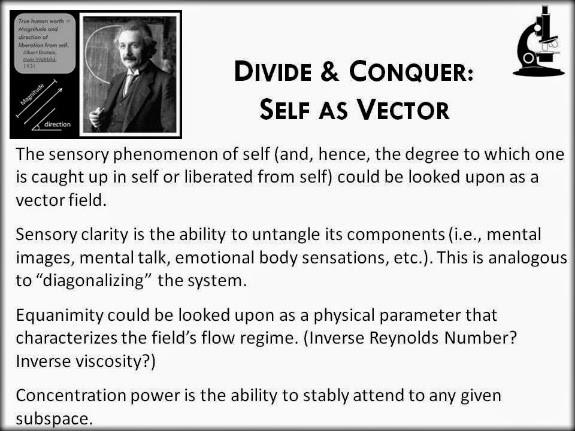

So Einstein said: “True human worth equals the magnitude and direction of liberation from self.” What’s revealing about this quote is that Einstein, having been trained in mathematics, is thinking of the endeavor of transcending self as a vector-valued function rather than a scalar-valued function. Translated into ordinary English, that means that in fact “No Self” is a multi-dimensional phenomenon. Put another way, there are various sizes and flavors of experience that might be described as No Self.
One flavor of No Self would be a spontaneous deactivation of inner See-Hear-Feel activity (See Chapter 1 of my manual).
Another flavor of No Self comes about when the mind-body elements get disentangled (See The Five Khandhas paradigm of early Buddhism).
Yet another flavor of No Self comes about when we dis-identify with the Content of mind and body and re-identify with the Flow (See Chapter 4 of my manual) and Contour of mind and body.
Yet another flavor of No Self comes about when we can detect the continuous goneness of every experience and, furthermore, identify with the Goneness and disidentify with the mind and body.
As to the central point in your question, which, if I paraphrase, boils down to
The quick answer is “the habit of meditating is meditating,” just like the habit of driving the car can drive the car even when you have no conscious perception of a driver.
For more details see the following videos (with thanks to Har-Prakash Khalsa):
“If there is no self in All Rest…then who is seeing and noting?”
I give a standard power point presentation that outlines my hope for how science and mindfulness could cross-fertilize with each other to the dramatic benefit of humanity. In that presentation, I mention an interesting quote by Albert Einstein. Here are the relevant slides.
So Einstein said: “True human worth equals the magnitude and direction of liberation from self.” What’s revealing about this quote is that Einstein, having been trained in mathematics, is thinking of the endeavor of transcending self as a vector-valued function rather than a scalar-valued function. Translated into ordinary English, that means that in fact “No Self” is a multi-dimensional phenomenon. Put another way, there are various sizes and flavors of experience that might be described as No Self.
One flavor of No Self would be a spontaneous deactivation of inner See-Hear-Feel activity (See Chapter 1 of my manual).
Another flavor of No Self comes about when the mind-body elements get disentangled (See The Five Khandhas paradigm of early Buddhism).
Yet another flavor of No Self comes about when we dis-identify with the Content of mind and body and re-identify with the Flow (See Chapter 4 of my manual) and Contour of mind and body.
Yet another flavor of No Self comes about when we can detect the continuous goneness of every experience and, furthermore, identify with the Goneness and disidentify with the mind and body.
As to the central point in your question, which, if I paraphrase, boils down to
“If there is no self, who is meditating?”
For more details see the following videos (with thanks to Har-Prakash Khalsa):
- Self-Enquiry & Mindfulness Meditation
- The Absolute Witness
- From Surface to Source & the Gold Standard for Spiritual Maturity
July 17, 2014
Observing vs. Developing

You may be familiar with the work of Charles Tart, the person primarily responsible for popularizing the phrase “altered states”. Charley and I have been friends for a very long time and frequently exchange emails. Here’s a recent example.
Date Composed: April 30, 2014Dear Shinzen,
Reading how mindfulness was done by Ledi Sayadaw within the scaffold of the Abhidhamma was very interesting. It’s clear from psychological and neurological research that “perception” is not just taking a camera-doesn’t-lie photo, it’s a cognitive act, a construction. Automated, too fast, usually, for people to distinguish the jump from, to use the Tibetan frame, sixth consciousness to seventh consciousness.
This makes me appreciate your reframing even more. To “label” (implicitly or explicitly) an observation that something in the quality of my experience has changed as “impermanence” makes me feel sophisticated and Buddhist, but that’s really jumping a long way from direct observation, “bare attention” to theory, interpretation. Whereas labeling it more directly as in your approach, with more direct words like “increase” or “decrease” or “gone” is sticking close to the data, to switch to scientific phrasing, without forcing the data into a theoretical framework.
Since our minds are expert at (subtly) altering perceptions to fit beliefs, I think it’s wiser to not confuse observation and theorizing.
It’s not that clean a distinction, of course, as sometimes having a theoretical/descriptive system to fit observations into makes you more sensitive, but it can lead to distortion. My personal observation, e.g., that the inner talk and imagery of my mind is constantly changing is an observation. Declaring that “impermanence” is a fundamental property of the universe, on the other hand, is a big, big jump….
Anyway, thanks for what I’m calling the “cleanness” of your approach!
Charley
Hi Charley,
If there’s a cleanness to my approach, you can take some credit for that. Dialogues with people like you have helped me clarify many issues. I used to buy the claim that mindful practice involves nothing more than observing “just what is.” Of course, it’s true that as discrimination and detection skills grow, one starts to be aware of important things that were always there but were unnoticed previously. On the other hand, the techniques themselves may influence the form experience takes. That influence can be at a gross level or a subtle level.
Let’s start with gross impact. The gross level is what you refer to in your email. It’s characteristic of some people who work within the Mahasi tradition. They explicitly ask the student to experience the Three Marks of Existence – anicca, dukkha, anatta – in each sensory phenomenon that they note. Personally I would not encourage people to intentionally try to do that. It’s not that I think there’s something fundamentally wrong with doing so. In fact I think it’s a fine strategy that often works. The only reason I don’t encourage it is that I don’t want to set students up for failure, i.e., if they can’t perceive the Marks, then it fortifies the “I am less than” belief that so many people have. However I do sensitize people to the fact that a given sensory event may either be stable or changing, but I do that in a way wherein there is no implied preference for one possibility verses the other. And I do have students try to see that Suffering = Discomfort x Resistance. Finally, I do point out to students that if they happen to notice an “All Rest” moment within the inner system of See-Hear-Feel, that there won’t be a self there. In my way of thinking, sensitizing to the possibility of something is different from asking a person to find that thing.
Now let’s discuss the subtle impact.
The subtle way that mindfulness techniques might alter experience is that they can create positive feedback loops. For example, flow is usually a more pleasant way of experiencing the senses than is solid—and usually more efficient to boot! So naturally, the more you focus on flow, the more flowing the senses become. It happens automatically, natural selection at work on a small time scale.
In my current way of looking at mindfulness, I see neither the gross levels of impact nor the subtle ones to be in the slightest problematic. Mindfulness has a dual nature. On one hand, it’s a little bit like science where you observe what is with awareness extending tools. On the other hand, it’s also like going to the gym, where you intentionally alter the fabric of your being—but in a way that’s both natural and in the service of life. At the gym, muscle is broken down then grows back stronger. On the cushion, self is broken down then grows back cleaner.
As far as “seeing what’s really there” goes, one might distinguish three levels of claim with regards to what meditation does. The strongest claim is that meditation reveals important things about the objective nature of the real world. A somewhat more modest claim is that meditation reveals important things about the nature of consciousness and does nothing else. (By the way, for me consciousness ≡ sensory experience.) The weakest claim is that meditation reveals certain things about the nature of sensory experience but also alters sensory experience in a way that is conducive to human happiness. Historically, the great majority of contemplative masters make the strongest claim. Personally I think it’s intellectually safer to make the weakest claim. (Even the weak claim is highly non-trivial!) However, I would not in the slightest be surprised if the strongest claim turns out to be valid. Only time will tell. As Francis Darwin said, glory in science belongs not to the person who first states something true and important but rather to the person who first proves it!
Once again, I have you to thank for sharpening up my thinking around these issues.
All the best, Shinzen
Subscribe to:
Posts (Atom)